

Global Engineering Days
The Line
A rip in the daily grind continuum
Global Engineering Days is Intuit's twice-yearly engineering hackathon: a week to leave the roadmap behind and build. The theme was portals: a doorway out of the ordinary. And the problem was linguistic. Portals have almost no idioms to draw on, and the closest, "a rip in the space-time continuum," doesn't land in a second. So I went hunting for a phrase that sounds like space-time but means the thing a portal actually tears you out of: the daily grind.


The Assignment
Global Engineering Days (GED) is Intuit's week-long, twice-yearly internal innovation event: a company-wide hackathon where engineers step away from their roadmaps to build whatever they think matters. It's big, with thousands of participants across 13 global sites, a high NPS that we want always want to improve, and enough shipped ideas to fill a product backlog. I lead the creative and copywriting for it.
A hackathon lives or dies on energy, and I wanted to give it a theme worth showing up for. The work is serious, but technologists love a fun reference. More importantly, they love that a hackathon feels like an escape: a reason to leave the daily grind and build something. We wanted some theatricality and creative risk, and landed on portals.
The Work
A portal is a doorway to somewhere else, and that's exactly what GED is for a technologist: a rip in the ordinary week that drops you into a place with no roadmap, no tickets, no limits. The metaphor did three things at once. It framed the event as an escape from routine. It carried a builder's optimism — a portal goes somewhere. And it gave our brand designers a visual system with real range: geometric portal shapes, depth, motion, a world you could step through. The design was strong. My job was to make the copy live up to it.


The Writing Challenge
I loved our theme, but realized that I set myself up for a ton of work when I started to dig into the words. Portals are a rich subject, but there's no rich well of portal expressions the way there is for, say, time or travel. The closest thing in the language — "a rip in the space-time continuum" — gestures at the right feeling, that sense of the ordinary tearing open, but it's a mouthful, it's sci-fi, and it doesn't grok on a wall in half a second.
So I had a decision to make: work from the short, less inspiring list of real portal idioms, or build something new. I played around with a mix of expressions, from portal wordplay to playing with the "GED" acronym to breaking the fourth wall. As frustrated as I was at times, the copy was fun:
From the cutting-room floor
-
Sorry we missed your Slack. We're in a better dimension.
-
We put the 'portal' in 'hypophysioportal.' We don't know that word either. Just come to GED.
-
Now coding in four dimensions
-
There aren't too many interdimensional rips in space-time that will help you follow your passion.
-
Go through this portal to / Explore, innovate and improve and / Dazzle everyone with what you build
-
Interdimensional and ready to party
The Line
With the final line, I looked for phrases that sound like "space-time continuum" and carry an everyday meaning underneath. The line that won hid the new idea inside a phrase everyone already owns: A rip in the daily grind continuum.
It keeps the cadence and mouthfeel of "space-time continuum" — the reader hears the reference — but swaps in "daily grind," which is precisely what GED tears you out of. It's a coined phrase that reads as if it always existed, landing easily and staying specific to the event while making the metaphor do work instead of just decorating.
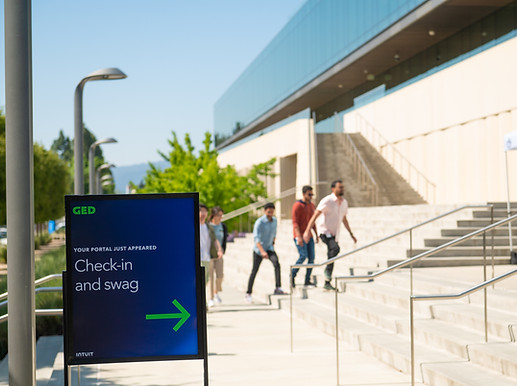
From there the voice extended across the event. A companion line, "Your portal to collaboration," ran on the die-cut signage. Wayfinding leaned into it: "Your portal just appeared" over the check-in area. The system held because the central idea was solid enough to build on.

The Game
The copy extended into a playable AR game I wrote.


The Results
The theme carried a week of building across 13 global sites for roughly 6,600 technologists. The event scored an NPS of 75, and the spring cycle we ran lifted the numbers across the board versus the prior one: registration rose 14% (about 640 more people) and projects rose 11%, while shifting the event toward in-person attendance. The system also proved scalable: the portal decals and the Time Defender AR game were built to run across every site at once. The copy and design didn't just theme one event — they became a repeatable kit.
+14% Registration · +11% Projects
~6,600 technologists across 13 sites, NPS 75